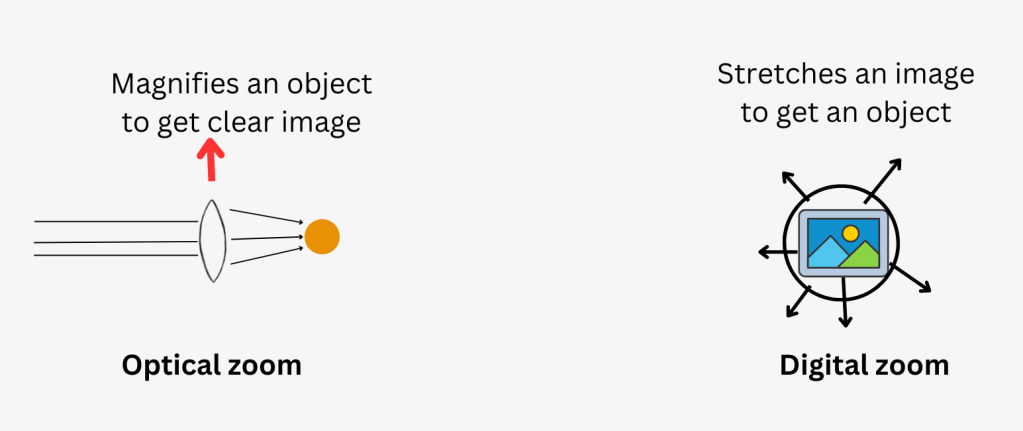
Understand how these zooming techniques affect image quality, clarity, and overall camera performance. Our detailed comparison guide breaks down the pros and cons of each, helping you make informed decisions for better results.
| Features | Optical zoom | Digital Zoom |
|---|---|---|
| Quality | Preserved quality image | Lower quality with more pixelated image |
| Magnification | True magnification | Simulated magnification using cropping and resizing |
Understanding Optical zoom
Optical zoom in photography refers to the actual physical lens magnification. Optical zoom allows photographers to zoom in on distant subjects while maintaining image quality. This results in sharper, high-quality images without sacrificing resolution. Optical zoom provides professional-grade results with detail and sharpness even at maximum magnification. And it also capture intricate details and fine textures with precision, whether you’re photographing landscapes, wildlife, or architectural structures.
Explaining Digital zoom
Digital zoom is a feature found in cameras and smartphones. Digital zoom is essentially cropping and enlarging a portion of the image that allows you to get closer to distant subjects without the need for bulky zoom lenses. When you zoom in digitally, the camera enlarges the pixels in the image, resulting in a loss of quality and detail. Digital zoom can be handy for casual photography or situations where optical zoom isn’t available, it’s crucial to balance convenience with image quality considerations.
Pro’s and Con’s
Image quality
Optical zoom provides better image quality without sacrificing resolution when capturing distant subjects. Digital zoom magnifies the image by interpolating pixels, resulting in a loss of image quality and detail, especially at higher zoom levels which lead to pixelation, blurriness, and decreased sharpness.
Real-time pictures
Optical zoom provides their shots in real-time by adjusting the zoom ring on the lens. While, Digital zoom relies on software algorithms to simulate zooming, which can produce artificial-looking images with reduced dynamic range and color accuracy.
Low-light performances
Optical zoom lenses allow more light to enter the camera sensor, improving low light performance which reduces the need for flash and minimizes image noise. Digital zoom cameras may struggle in low light conditions due to their smaller sensor size and reduced aperture capabilities.
Cost-wise
Cameras with optical zoom capabilities often come with a higher price tag compared to digital zoom cameras. Digital zoom cameras are generally more affordable making them accessible to a wider range of users. This makes digital zoom cameras a cost-effective option for beginners or budget-conscious photographers.
Zoom range
Optical zoom lenses typically have a fixed zoom range, which may not be sufficient for capturing distant subjects. In situations where extreme zoom is required. Whereas Digital zoom extends the reach of the camera lens beyond its optical capabilities, allowing users to magnify distant subjects even further.
https://www.adorama.com/alc/choose-first-lens-buying-guide-beginners
Conclusion
The decision between optical zoom and digital zoom boils down to image quality versus convenience which hinges on your photography goals and standards. Optical zoom magnify distant subjects without sacrificing quality, suits those seeking professional-grade images. Digital zoom relies on software interpolation, often resulting in pixelation and loss of clarity.. Therefore, for superior image clarity and precision, optical zoom emerges as the preferred choice for discerning photographers.
 Healing corner
Leave a comment